Mathematics, Physics and Technology:
Charge Transport, Nonlinear Waves and Mathematical Modeling
Department of Mathematics and Computer Science, University of Catania, Italy, 9 — 11 September 2026



Special session dedicated to the scientific activity of Prof. Vittorio Romano
Scope
The conference brings together researchers working at the intersection of mathematical physics, applied mathematics, and the mathematical modeling of physical and technological systems. The scientific program covers a broad spectrum of topics that reflect the current frontiers of research in these interconnected fields.
Key topics include:
- charge and phonon transport in semiconductors
- graphene and low-dimensional materials
- nonlinear waves, shock waves, and radiation hydrodynamics
- numerical methods and optimal control
- extended thermodynamics and group analysis
The field of semiconductor modeling is going through rapid development involving mathematics, physics, engineering, and beyond. This conference aims to foster interdisciplinary exchange among researchers from all these communities. Contributions from both early-career researchers and established scientists are warmly encouraged.
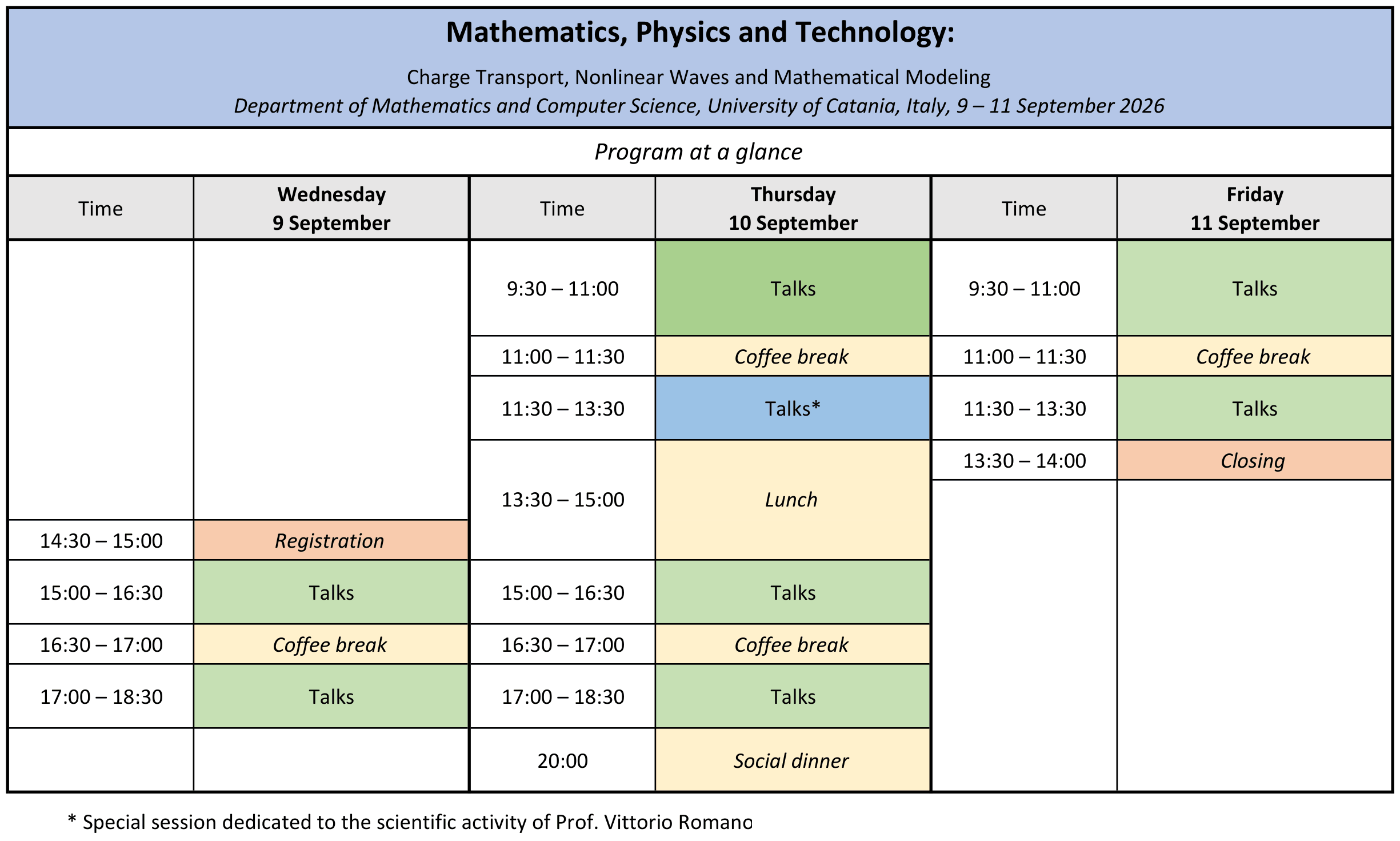
Program at a glance
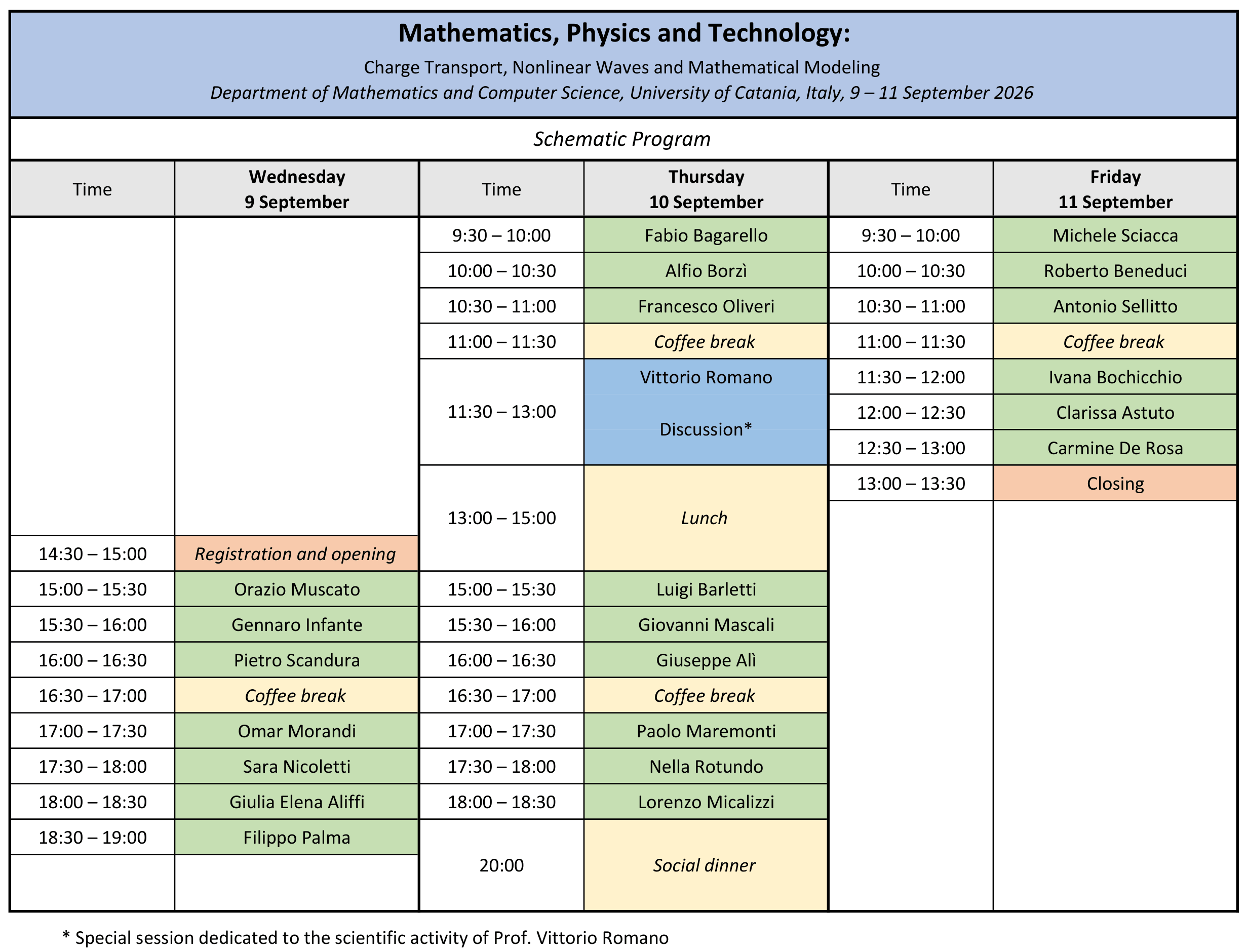
Schematic Program
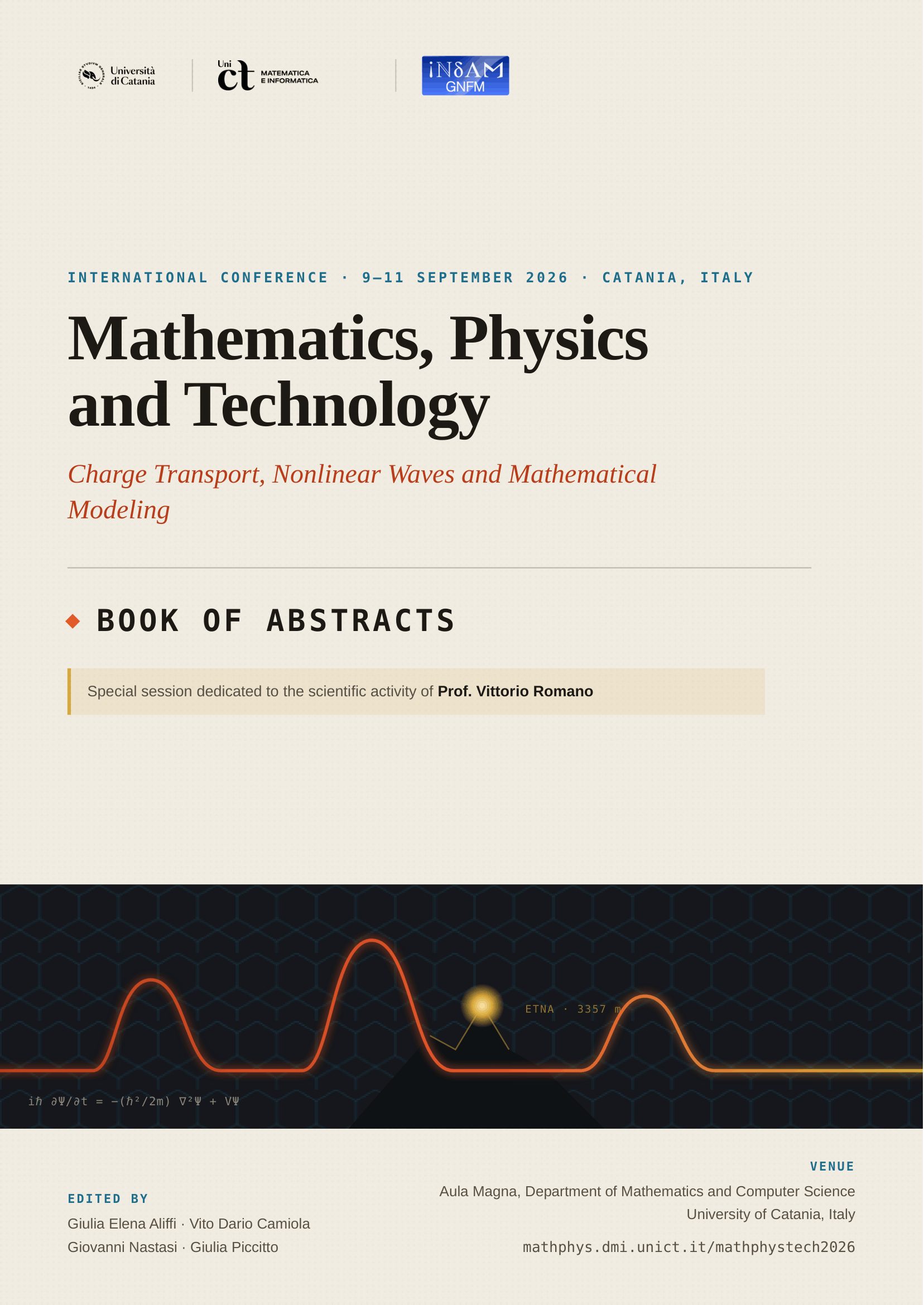
Book of Abstracts
Scientific Committee
- Fabio Bagarello, University of Palermo, Italy
- Luigi Barletti, University of Florence, Italy
- Orazio Muscato, University of Catania, Italy
- Francesco Oliveri, University of Messina, Italy
- Andrea Sacchetti, University of Modena and Reggio Emilia, Italy
Organizing Committee
- Giulia Elena Aliffi, University of Catania, Italy
- Vito Dario Camiola, University of Catania, Italy
- Giovanni Nastasi, University of Enna "Kore", Italy
- Giulia Piccitto, University of Catania, Italy
List of Participants
- Giuseppe Alì, University of Calabria, Italy
- Giulia Elena Aliffi, University of Catania, Italy
- Clarissa Astuto, University of Catania, Italy
- Fabio Bagarello, University of Palermo, Italy
- Luigi Barletti, University of Florence, Italy
- Roberto Beneduci, University of Calabria, Italy
- Ivana Bochicchio, University of Salerno, Italy
- Alfio Borzì, University of Würzburg, Germany
- Vito Dario Camiola, University of Catania, Italy
- Manuela Carini, University of Calabria, Italy
- Carmine De Rosa, University of Trento, Italy
- Francesco Gargano, University of Palermo, Italy
- Matteo Gorgone, University of Messina, Italy
- Luca Heltai, University of Pisa, Italy
- Gennaro Infante, University of Calabria, Italy
- Paolo Maremonti, University of Campania “Luigi Vanvitelli”, Italy
- Giovanni Mascali, University of Calabria, Italy
- Lorenzo Micalizzi, North Carolina State University, USA
- Omar Morandi, University of Florence, Italy
- Orazio Muscato, University of Catania, Italy
- Giovanni Nastasi, University of Enna “Kore”, Italy
- Sara Nicoletti, University of Florence, Italy
- Francesco Oliveri, University of Messina, Italy
- Filippo Palma, University of Campania “Luigi Vanvitelli”, Italy
- Annunziata Palumbo, University of Messina, Italy
- Giulia Piccitto, University of Catania, Italy
- Patrizia Rogolino, University of Messina, Italy
- Vittorio Romano, University of Catania, Italy
- Nella Rotundo, University of Florence, Italy
- Lidia Saluto, University of Palermo, Italy
- Pietro Scandura, University of Catania, Italy
- Maria Antonietta Scarcella, University of Calabria, Italy
- Michele Sciacca, University of Palermo, Italy
- Antonio Sellitto, University of Salerno, Italy
- Vincenzo Tibullo, University of Salerno, Italy
- Rita Tracinà, University of Catania, Italy
Registration
The registration to the workshop is free but mandatory.
The participants are invited to complete the online registration form at the following link.
https://forms.gle/WM8u5jFLac38whAy6
Venue
The University of Catania
The University of Catania, located in the historic city of Catania on the eastern coast of Sicily, Italy, stands as a prestigious institution with a rich academic tradition. Established in 1434, it is one of the oldest universities in Italy and has played a significant role in shaping the cultural and educational landscape of the region. The University offers a diverse range of undergraduate and postgraduate programs across various disciplines, including natural sciences, engineering, social sciences and humanities. With a strong emphasis on research and innovation, the University of Catania actively engages in cutting-edge projects and collaborations, both at the national and international levels. The campus itself reflects a blend of historical architecture and modern facilities, providing students with a stimulating learning environment.
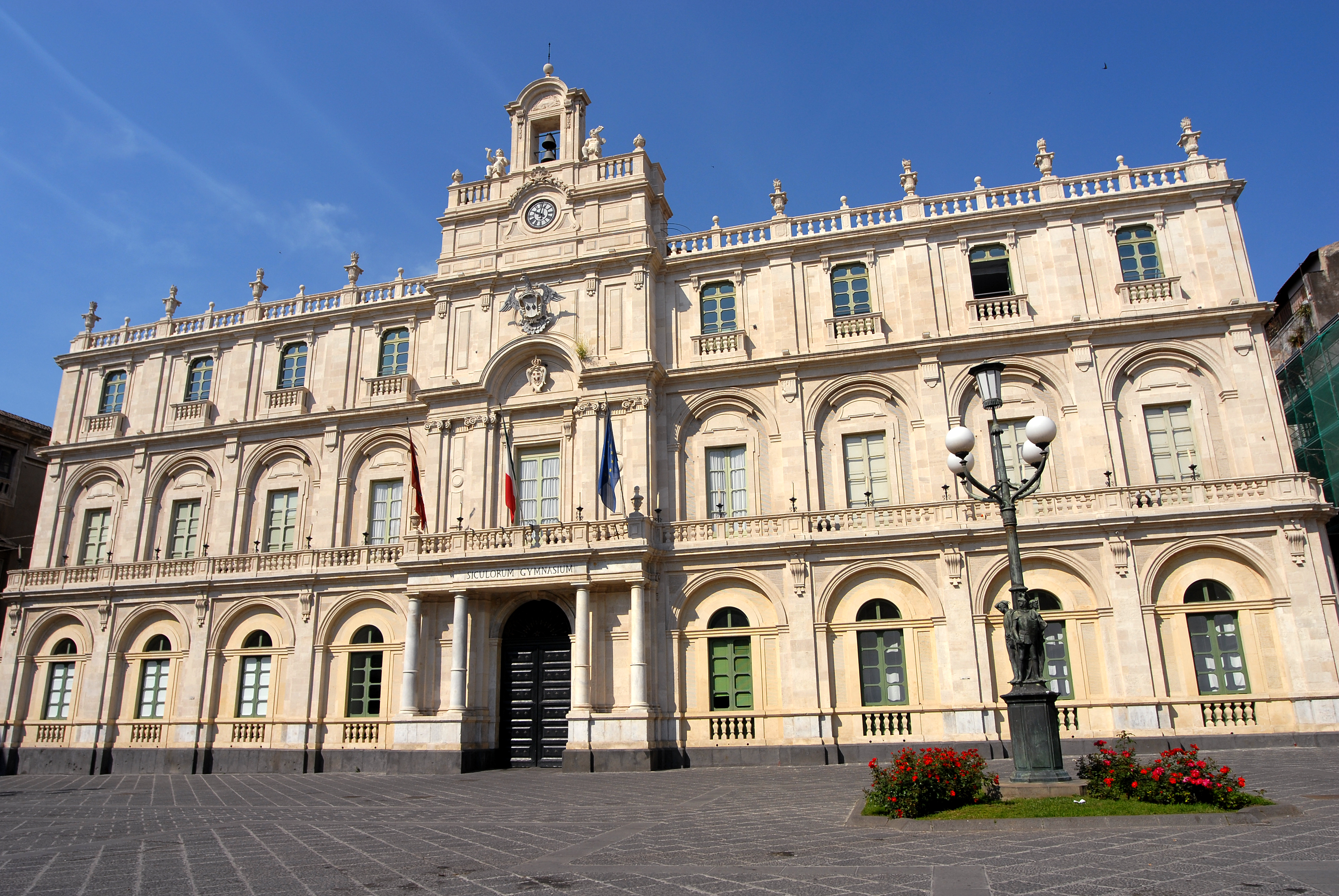
The Department of Mathematics and Computer Science
The conference will take place in the Aula Magna of the Department of Mathematics and Computer Science, Viale Andrea Doria 6, 95125 Catania, Italy, located within the main Cittadella Universitaria campus.
The School of Mathematical Sciences is one of the oldest academic institutions at the University of Catania. The Institute of Mathematics was originally housed in the University’s historic central building in the city centre. After the end of the Second World War, it moved to new premises on the top floor of the Palace of Sciences and was reorganized under the name Seminario Matematico.
The Department of Mathematics and Computer Science, known within the University of Catania by the acronym DMI, was established in its current form in 1990, when the members of the former Department of Mathematics joined researchers working in the field of Computer Science. The Department is located on the University’s main campus, known as the Cittadella Universitaria, and is devoted to coordinating, developing, and promoting research and education in Mathematics and Computer Science. It currently has an academic staff of approximately 80 members.
The Department also includes a Computing Centre and a specialized library holding more than 900 scientific journals and over 70.000 scientific books. The Computing Centre provides facilities supporting research, teaching, and administrative activities. Its laboratories contain approximately 130 computer workstations with flexible configurations. The Centre also hosts a node of the regional computing grid, which extends throughout Sicily and is connected to major national and international research infrastructures.
Catania sights
Catania is a city located on the eastern coast of the island of Sicily in Italy. It is the second-largest city in Sicily, after Palermo. Catania is situated at the foot of Mount Etna, one of the most active volcanoes in the world, which has had a significant impact on the city's history.
The city has a rich historical and cultural heritage, with various architectural styles reflecting its diverse past. Catania has faced several natural disasters, including earthquakes and volcanic eruptions, but it has been rebuilt multiple times throughout its history.
Key landmarks in Catania include the Baroque-style Cathedral of Saint Agatha, the historic Elephant Fountain (Fontana dell'Elefante), and the Ursino Castle. The city is also known for its vibrant street markets, lively atmosphere, and delicious Sicilian cuisine. Catania serves as a gateway to exploring the surrounding natural attractions, such as Mount Etna and the beautiful Sicilian coastline.


Restaurants and bars
Sicilian cuisine is a rich and diverse blend of flavors, influenced by the various cultures that have inhabited the island over the centuries, including Greeks, Arabs, Normans, and Spanish.
Catania offers a wide range of dining experiences. In the map below you can find the areas where many restaurants and bars are present.
Don't forget to try the street food and the desserts prepared in the bars of the city center.
Information
Accommodation
A not exhaustive list of accommodations placed at a walking distance from the conference building can be found below.
How to reach Catania
By plane
The International Airport of Catania (CTA) is located 7 km from the city center. It is the main airport of the eastern coast of Sicily. There are airports in Comiso (CIY) 100 km, Palermo (PMO) 250 km, Trapani (TPS) 330 km. It is strongly recommended to land in Catania, if you plan to travel through another airport check carefully the connections to Catania.
By train
The main train station of the city is Catania Centrale. It is connected to the main cities of Sicily and also with long distance trains to the rest of Italy. The Catania Centrale station is also connected with local buses and the metro.
By bus
The main bus station of the city is located close to the train station of Catania Centrale. The main companies that connects Catania to the other main cities of Sicily are SAIS and Interbus.
How to reach the conference
From the Airport
From the International Airport of Catania it is possible to reach the city center by bus with the line Alibus. Check the time schedule on the AMTS website. To reach the conference directly, get off at the bus stop Viale, walk to Piazza Roma and take the bus line BRT1 at the stop Santa Sofia Cittadella (1). Tickets are available on the AMTS Catania app or Dropticket.
From the train station
From the Catania Centrale train station it is possible to reach the Department by local buses. Check the lines and the time schedule on the AMTS website. Another possibility is to take the metro at the stop Giovanni XXIII and get off at the stop Stesicoro. More information on the Circumetnea website.
From the city center
You can reach the Department via local transit in two ways: take the Metro to Milo station and transfer to the BRT1 bus, or take the BRT1 line directly. Either way, get off at the Santa Sofia Cittadella (1) stop. Tickets are available on the AMTS Catania app or Dropticket.
Contacts
- Vito Dario Camiola, University of Catania, Italy (dario.camiola@unict.it)
- Giovanni Nastasi, University of Enna "Kore", Italy (giovanni.nastasi@unikore.it)